
| Insecta : Lepidoptera : Noctuidae | Butterflies and Moths |
Apamea furva Cockayne, 1950
Confused
 |
| Apamea furva |
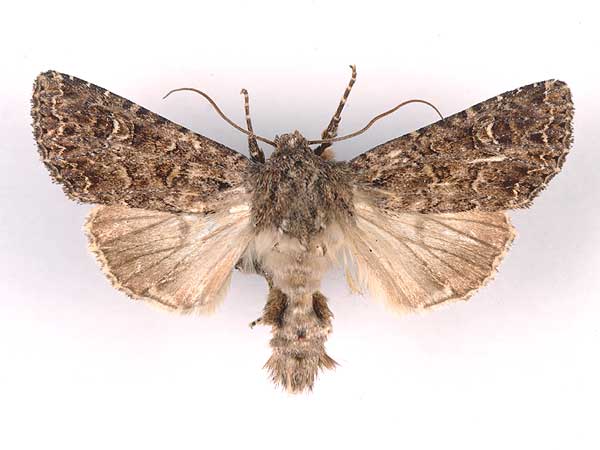
Description: Wingspan 34-42 mm. Forewings dark brown and pointed at apex. Stigmata squarish and paler than the ground colour. Crosslines are poorly defined and the subterminal line is pale and irregular. Hindwings light fuscous, darker towards the outer margin. Unknown in N. Ireland. Skinner gives July and August as the main flight period in Britain.
World Distribution: Eurasiatic: In western Europe it is primarily montane in the southern parts of its range through Spain and Portugal. It occurs as far north as the Arctic Circle.
Irish Distribution: Unknown. The only recent record for this species is from Rathlin Island, Antrim in 1988. Its resemblance to the Dusky Brocade may mean it has been overlooked in some suitable areas especially in Antrim. Baynes describes it as being rare and local but widely distributed in Ireland. Donovan gave records for Londonderry, Tyrone and Armagh. It is primarily a northern species and not uncommon in Scotland, which would account for its presence on Rathlin and perhaps in other suitable areas in the north. In southern Ireland it has been reported from Cos. Donegal, Sligo, Kerry, Cork, Waterford and Dublin.
Ecology: An upland species found in moorland and coastal rocky habitats. Adults are attracted to light and also flowers, especially those of Common Ragwort Senecio jacobaea, Red Valerian Centranthus ruber, Wild Thyme Thymus polytrichus and possibly other species. The larvae feed from September to June on various grasses. It overwinters as a larva.
Key Identification Features:
- Pointed forewings
- Square-shaped stigmata
- Light coloured hindwings
Distribution Map from NBN: Apamea furva at National Biodiversity Network mapping facility, data for UK.
iNaturalist: Apamea furva at iNaturalist World Species Observations database.
| Thompson, R. & Nelson, B. (2023). Apamea furva. Cockayne, 1950. [In] Moths of Northern Ireland. https://habitas.org/moths/species.php?item=6428. Accessed on 2026-11-02. |