
| Insecta : Lepidoptera : Noctuidae | Butterflies and Moths |
Orthosia munda (Denis & Schiff., 1775)
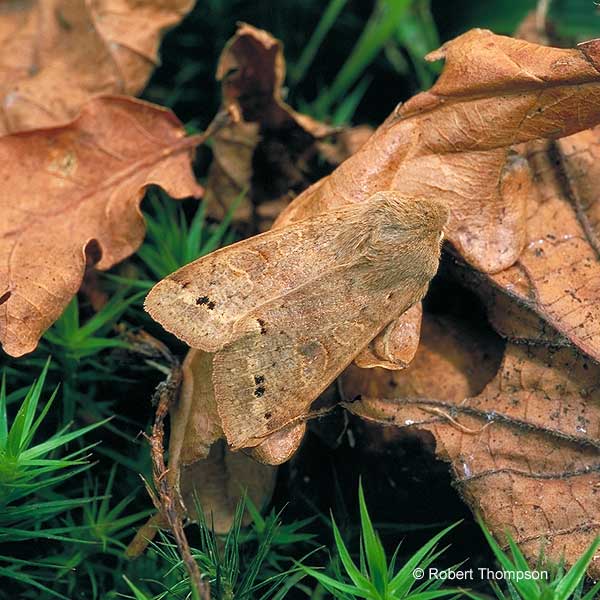
Twin-spotted Quaker
 |
| Orthosia munda |
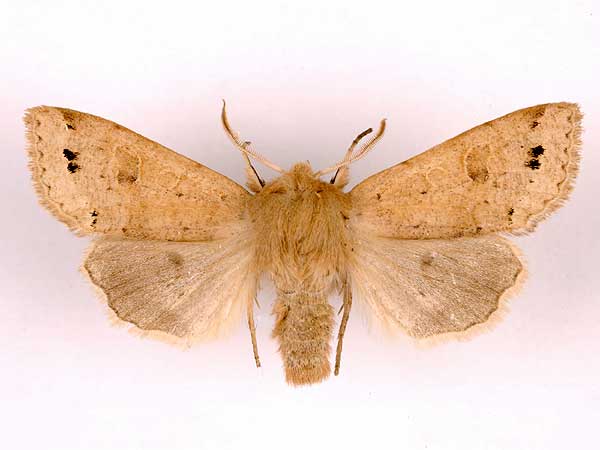
Description: Wingspan 38-44 mm. Adults are variable both in colour and markings and there are many named forms. Forewing colouration ranges from light ochreous brown through to dark ochreous. Stigmata are not well defined and the subterminal line is faint and often reduced to a pair of black median dots. Crosslines are not always well defined but more obvious in lighter forms. Hindwings are fuscous with a small dark discal spot, although this is not always clearly defined. Early March to the beginning of May.
World Distribution: Northern Europe; throughout Belgium, northern France, the Netherlands east to Russia.
Irish Distribution: Widely distributed in Armagh and Down and apparently scarce elsewhere. Known from a few well scattered localities in Fermanagh. Absent from most of Tyrone and northern counties with the exception of Traad Point, Londonderry in 1990 and White Park Bay, Antrim in 1940.
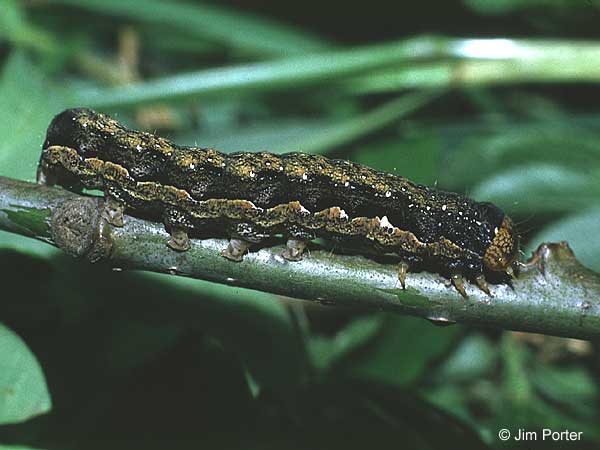
Ecology: An early spring species associated mainly with woodland habitats. Adults come frequently to light and also to willow Salix spp. catkins. Its early flight period may account for the scarcity of records, as it should exist more widely in other suitable habitats, especially in Fermanagh. The larvae feed during May and June on willow Salix spp., oak Quercus spp. and Aspen Populus tremula.
Key Identification Features:
- Two black median dots on forewings
- Small dark apical mark at costal edge
- Discal spot on hindwings
 |
 |
Distribution Map from NBN: Orthosia munda at National Biodiversity Network mapping facility, data for UK.
iNaturalist: Orthosia munda at iNaturalist World Species Observations database.
| Thompson, R. & Nelson, B. (2023). Orthosia munda. (Denis & Schiff., 1775). [In] Moths of Northern Ireland. https://habitas.org/moths/species.php?item=6282. Accessed on 2026-11-02. |