
| Insecta : Lepidoptera : Noctuidae | Butterflies and Moths |
Xestia triangulum (Hufnagel, 1766)
Double Square-spot
 |
| Xestia triangulum |
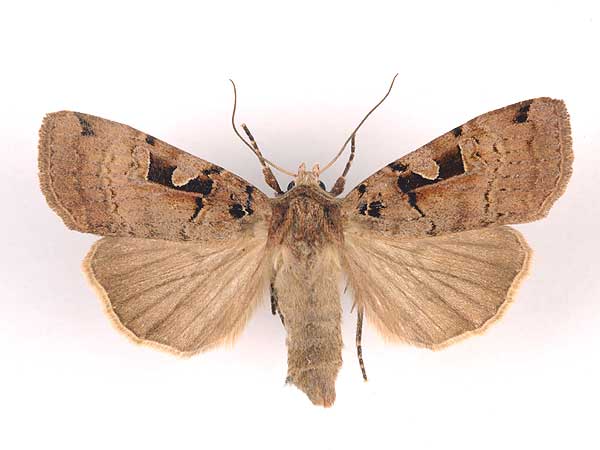
Description: Wingspan 36-46 mm. Forewings are ochreous brown with two small black square-shaped markings finely outlined in a paler colour. There is also a small black mark near the apex of the forewing. Hindwings are similar in colour to the forewings with darker veining. Mid June to late August.
World Distribution: Throughout western Europe as far north as central Scandinavia and south to Spain.
Irish Distribution: Common and widespread in southern counties, local in the north.
Ecology: This is typically a woodland species, although it is also found on some heaths and bogs. Adults are attracted to light and flowers. The larvae feed from September to the following spring on Blackthorn Prunus spinosa, Hawthorn Crataegus monogyna, willow Salix spp. birch Betula spp. and Bramble Rubus fruticosus. It overwinters as a larva.
Key Identification Features:
- Small black square-shaped markings on forewings
- Dark-coloured hindwings with darker veining
Distribution Map from NBN: Xestia triangulum at National Biodiversity Network mapping facility, data for UK.
iNaturalist: Xestia triangulum at iNaturalist World Species Observations database.
| Thompson, R. & Nelson, B. (2023). Xestia triangulum. (Hufnagel, 1766). [In] Moths of Northern Ireland. https://habitas.org/moths/species.php?item=6219. Accessed on 2026-11-02. |