
| Insecta : Lepidoptera : Noctuidae | Butterflies and Moths |
Euxoa tritici (Linnaeus, 1761)
White-line Dart
 |
| Euxoa tritici |
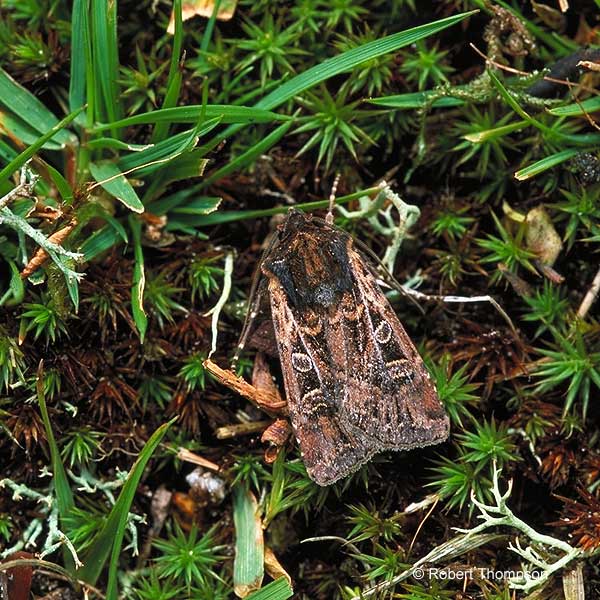
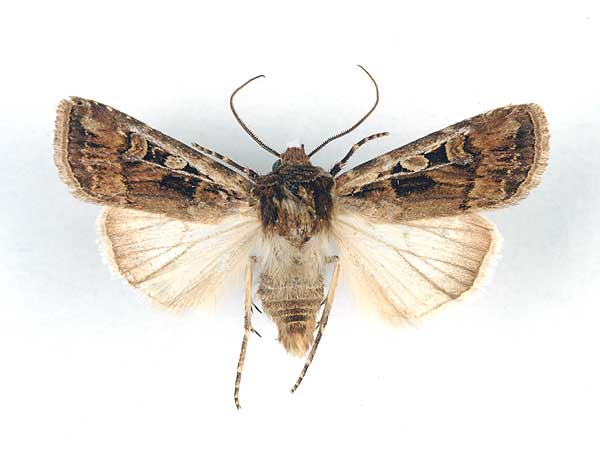
Description: Wingspan 28-40mm. The adults of this moth are very variable according to habitat. Forewing varies from pale, ochreous brown to dark chocolate brown. Most individuals have a pale, costal stripe. There are usually black, wedge-shaped marks near the outer margin of forewings. Stigmata are usually present but are also variable in size. Many specimens also have pale, whitish crosslines on the forewings. The hindwings are pale, whitish brown. Mid-July to mid-September, occasionally later in some years.
World Distribution: Eurasiatic; occurs as far north as Scandinavia south to Portugal.
Irish Distribution: Widely distributed but more common in the east, especially Down. A majority of records are from coastal localities, but there are inland records including suburban gardens in the Belfast area. Sporadic elsewhere, with records from Magilligan and the Umbra, Londonderry, and Whitepark Bay, Glenarriff Forest Park and Rathlin Island, Antrim.
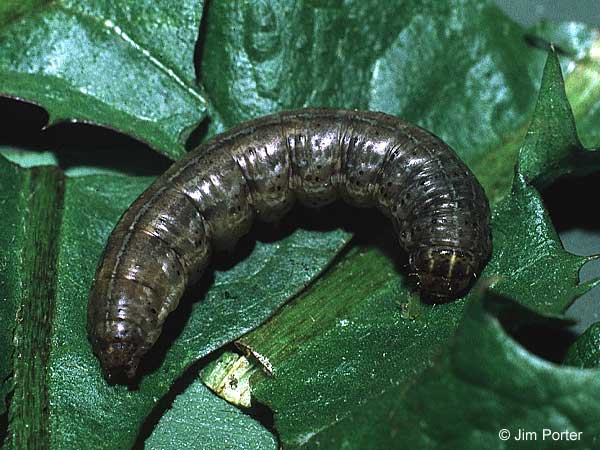
Ecology: A species mainly associated with coastal habitats in Ireland. Adults appear commonly at light. Adults visit flowers especially Ragwort Senecio jacobaea and Heather Calluna vulgaris. The larvae feed mainly at night on various herbaceous plants from March to June. It overwinters as an egg.
Key Identification Features:
- Pale costal stripe and crosslines
- Black wedge-shaped marks near the outer margin of forewings.
 |
 |
Distribution Map from NBN: Euxoa tritici at National Biodiversity Network mapping facility, data for UK.
iNaturalist: Euxoa tritici at iNaturalist World Species Observations database.
| Thompson, R. & Nelson, B. (2023). Euxoa tritici. (Linnaeus, 1761). [In] Moths of Northern Ireland. https://habitas.org/moths/species.php?item=6167. Accessed on 2026-11-02. |