
| Insecta : Lepidoptera : Lymantriidae | Butterflies and Moths |
Euproctis similis (Fuessly, 1775)
Yellow-tail
 |
| Euproctis similis |
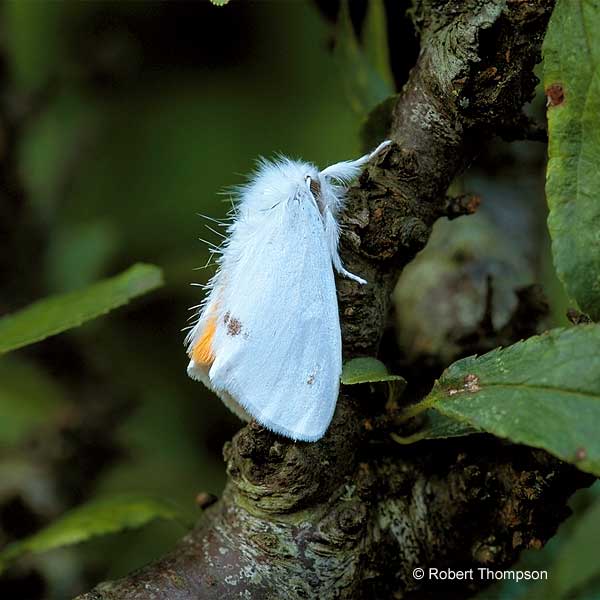
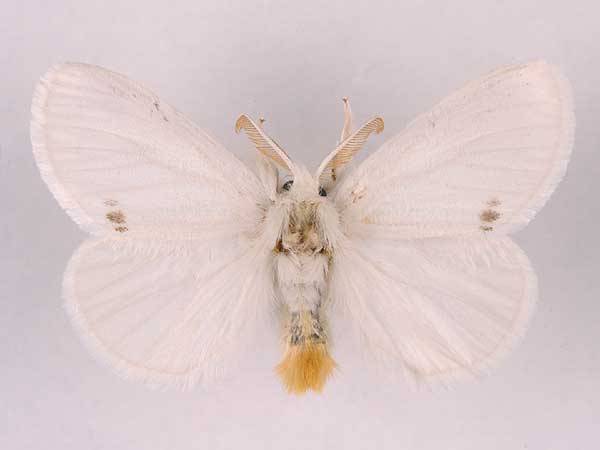
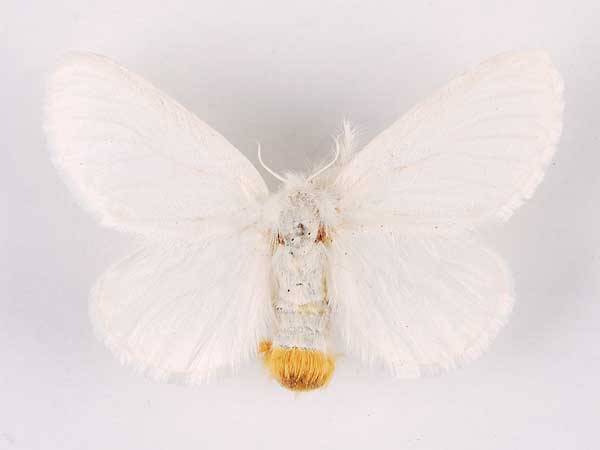
Description: Wingspan 35-45mm. Adults have a silky white appearance. Both sexes have a white body with a yellow anal tuft, which is often visible when the moth is at rest. The males have a small dark mark on the tornal aspect of the forewing. The hindwings are pale, silky-white. Mid-July to early August.
World Distribution: Throughout Europe and Asia as far east as China and Japan.
Irish Distribution: A scarce species, apparently confined to sites along or close to the east and north coast of Co. Down including Killard Point NNR, Greyabbey, Seaforde, Greencastle, Copeland Bird Observatory and Helen's Bay. It was first recorded in Ireland in the Dublin area in 1934 and N. Ireland in 1973. It seems to be spreading steadily west and northwards. Increased fieldwork along this coastline in the last few years has no doubt led to its discovery at many new sites.
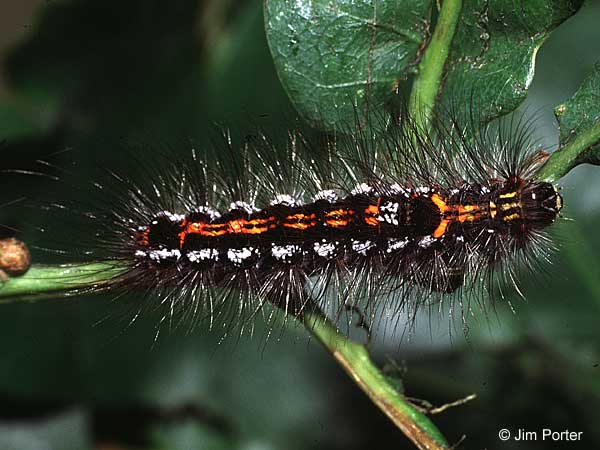
Ecology: A scarce, mainly coastal species, which is not often encountered, even from some of its well-known haunts. The coastal distribution suggests its distribution in N. Ireland is limited by climatic conditions. Adults are attracted to light but appear only occasionally in traps. The colourful larvae, which have the characteristic hump on the first segment, are gregarious during early instars. They are best looked for during the latter part of summer, prior to hibernation, on Hawthorn Crataegus monogyna, willow Salix spp., oak Quercus spp., and possibly other trees. It overwinters as a small larva.
Key Identification Features:
- Silky-white appearance
- Yellow anal tuft
- Dark-coloured marks on the lower aspect of the forewing (males only)
 |
 |
 |
Distribution Map from NBN: Euproctis similis at National Biodiversity Network mapping facility, data for UK.
iNaturalist: Euproctis similis at iNaturalist World Species Observations database.
| Thompson, R. & Nelson, B. (2023). Euproctis similis. (Fuessly, 1775). [In] Moths of Northern Ireland. https://habitas.org/moths/species.php?item=6116. Accessed on 2026-11-02. |