
| Insecta : Lepidoptera : Lymantriidae | Butterflies and Moths |
Dicallomera fascelina (Linnaeus, 1758)
Dark Tussock
 |
| Dicallomera fascelina |
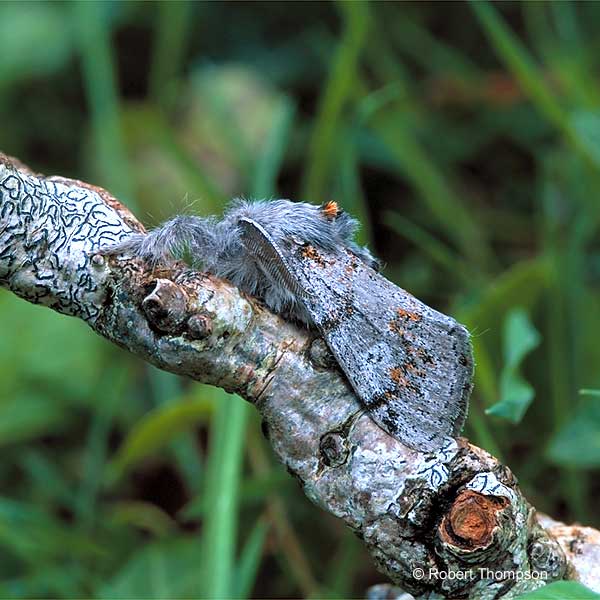
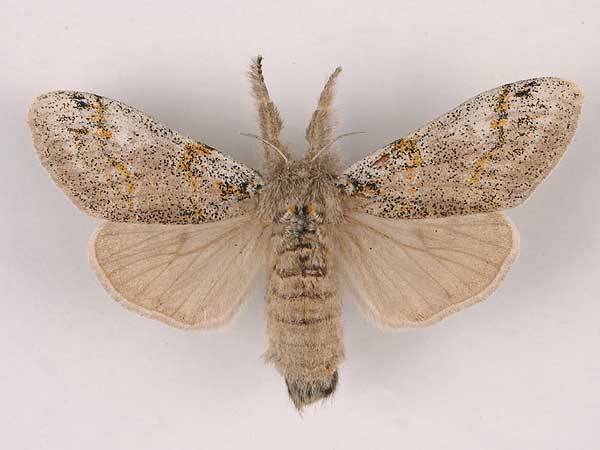
Description: Wingspan 40-53mm. Adults are generally a dull grey. The forewings are grey with dark costal marks, but in some specimens suffused with dark ochreous-yellow. There is also a black dotted line along the outer margin of the forewing. The hindwings are unmarked, pale grey. Early June to late July.
World Distribution: Throughout northern and central Europe as far east as Siberia.
Irish Distribution: A scarce, local species that is apparently restricted to a few boggy localities in north Armagh, including Peatlands Park and the Argory. There are old records from Tamnamore, Tyrone and Tempo, Fermanagh. It may occur more widely in upland areas in the west where recording has been less intensive.
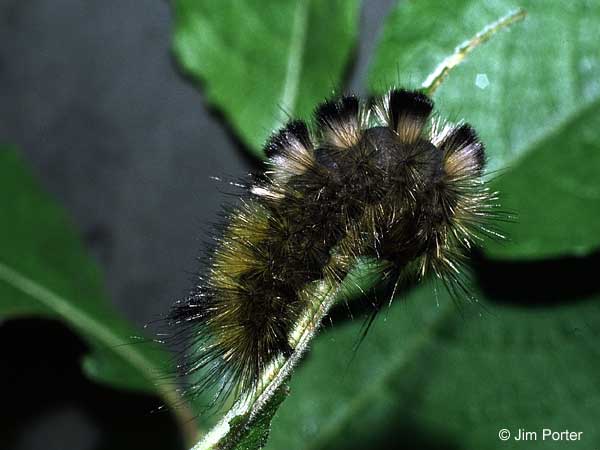
Ecology: An attractive species of intact bogs and moorland. Adults are attracted to light but appear only occasionally even at well-known localities. The larvae can be found in August and September and, after overwintering, in the May of the following year. They are occasionally seen resting exposed on the tips of heather stems in late summer prior to hibernation. They have been recorded on Heather Calluna vulgarisin N. Ireland. Other recorded foodplants include willow Salix spp., Broom Cytisus scoparius, birch Betula spp. and Bramble Rubus fruticosus. It overwinters as a larva.
Key Identification Features:
- Large hairy forelegs
- Dark costal marks
- Broken dotted line on outer margin of forewing
 |
 |
Distribution Map from NBN: Dicallomera fascelina at National Biodiversity Network mapping facility, data for UK.
iNaturalist: Dicallomera fascelina at iNaturalist World Species Observations database.
| Thompson, R. & Nelson, B. (2023). Dicallomera fascelina. (Linnaeus, 1758). [In] Moths of Northern Ireland. https://habitas.org/moths/species.php?item=6113. Accessed on 2026-11-02. |