
| Insecta : Lepidoptera : Notodontidae | Butterflies and Moths |
Furcula furcula (Clerck, 1759)
Sallow Kitten
 |
| Furcula furcula |
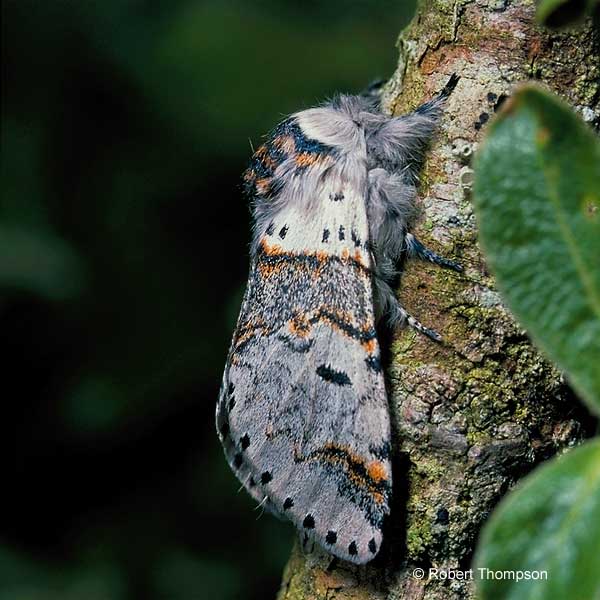
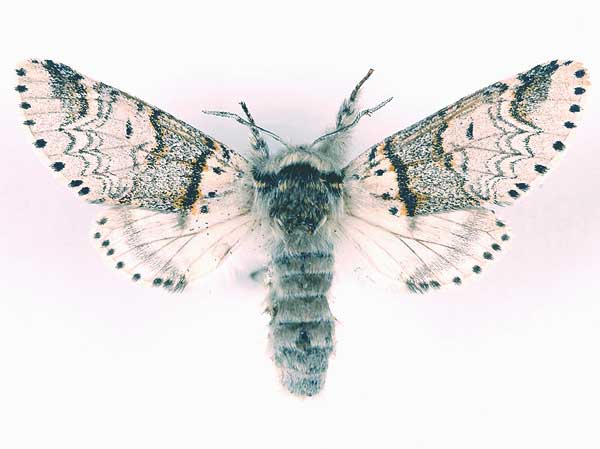
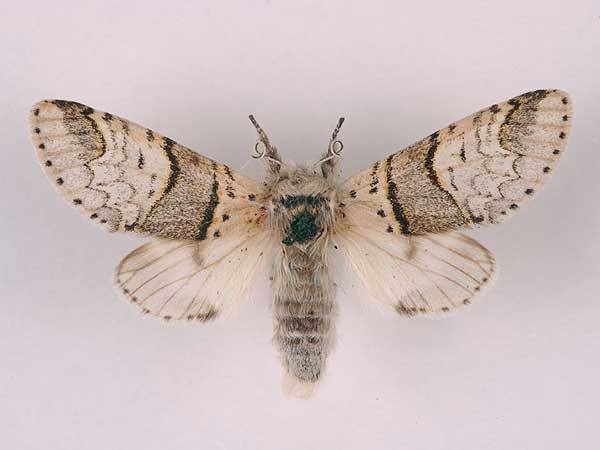
Description: Wingspan 35-42mm. Adults are white with a broad pale brown central band; there are also dark apical patches and a series of black dots above the band and along the outer edge of the forewing. The thorax is dark grey-brown and quite hairy. The abdomen is grey with darker banding between the segments. The hindwings are pale grey with brown veining and a series of black dots along the outer margin. Early June to late July.
World Distribution: Throughout Europe as far east as China.
Irish Distribution: A scarce species, found mainly in eastern counties in low density at well-known sites such as Seaforde and Belvoir Park, Down, Oxford Island NNR, Armagh and Portmore Lough, Antrim. Outside its strongholds of Down and north Armagh it has a scattered distribution. In the west it has been frequently taken at Crom Estate, Fermanagh but there have been no other recent records from either Tyrone or Londonderry. It was recorded from Banagher Glen and Traad Point, Londonderry in the 1970s.
Ecology: An attractive species similar in appearance to the Poplar Kitten F. bifida. This species favours damp woodland, where willows Salix spp. are common. Adults appear occasionally at light in very small numbers and also can be found resting on the trunks and stems of the foodplant. The larvae can be found from early July until August by examining the lower branches of small isolated bushes. It overwinters in a tough cocoon attached to the trunk or branch of a tree.
Key Identification Features:
- Broad pale brown central band
- Apical patches on forewings
- Hairy abdomen and thorax
- Black dots on outer margins of wings
 |
 |
Distribution Map from NBN: Furcula furcula at National Biodiversity Network mapping facility, data for UK.
iNaturalist: Furcula furcula at iNaturalist World Species Observations database.
| Thompson, R. & Nelson, B. (2023). Furcula furcula. (Clerck, 1759). [In] Moths of Northern Ireland. https://habitas.org/moths/species.php?item=6083. Accessed on 2026-11-02. |