
| Insecta : Lepidoptera : Notodontidae | Butterflies and Moths |
Furcula bicuspis (Borkhausen, 1790)
Alder Kitten
 |
| Furcula bicuspis |
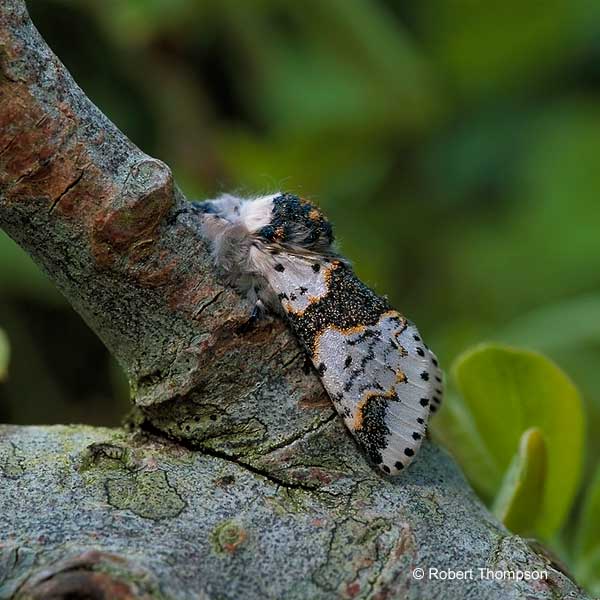
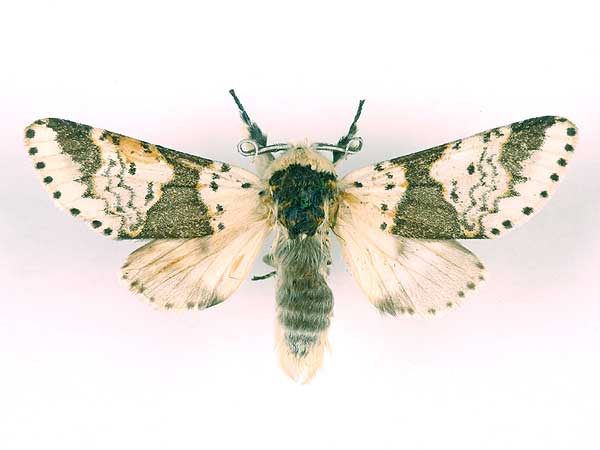
Description: Wingspan 40-48mm. Adults have white forewings with a broad, darkish-brown central band and dark patches near the apex of the forewing. There is also a series of black dots above the band and along the outer edge of the forewing. The thorax is dark grey-brown and quite hairy. The abdomen is white with grey bands between segments. The hindwings are white with brown veining. Mid-May to early July in Britain according to Skinner. Only one N. Irish record.
World Distribution: Throughout northern and central Europe as far east as Siberia.
Irish Distribution: Rare recorded at light for the first time in N.Ireland at Legatillida, Fermanagh in 2001. This is also the first record for this species in Ireland. In Britain it is quite local and mainly confined to western counties and parts of southeast England.
Ecology: A rare species, mainly associated with damp woodland and marshy areas. Skinner states that both sexes come frequently to light in small numbers. The larvae are similar in appearance to the other kittens and should be examined carefully to confirm identification. Skinner gives July to September as the most productive period for finding larvae. The recorded foodplants are birch Betula spp. and Alder Alnus glutinosa. It overwinters inside a tough cocoon attached to the trunk or branch of the foodplant.
Key Identification Features:
- Darker banding than other two kittens
- Dark patch at the apex of forewings
- White head and tip to the abdomen
 |
Distribution Map from NBN: Furcula bicuspis at National Biodiversity Network mapping facility, data for UK.
iNaturalist: Furcula bicuspis at iNaturalist World Species Observations database.
| Thompson, R. & Nelson, B. (2023). Furcula bicuspis. (Borkhausen, 1790). [In] Moths of Northern Ireland. https://habitas.org/moths/species.php?item=6082. Accessed on 2026-11-02. |