
| Insecta : Lepidoptera : Geometridae | Butterflies and Moths |
Biston strataria (Hufnagel, 1767)
Oak Beauty
 |
| Biston strataria |
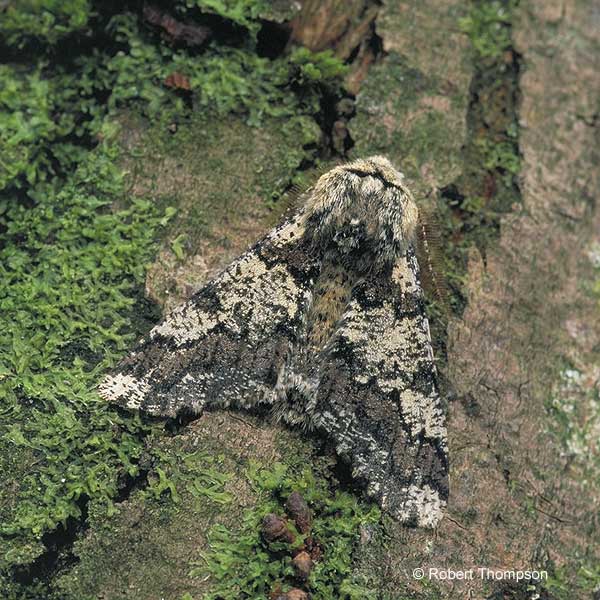
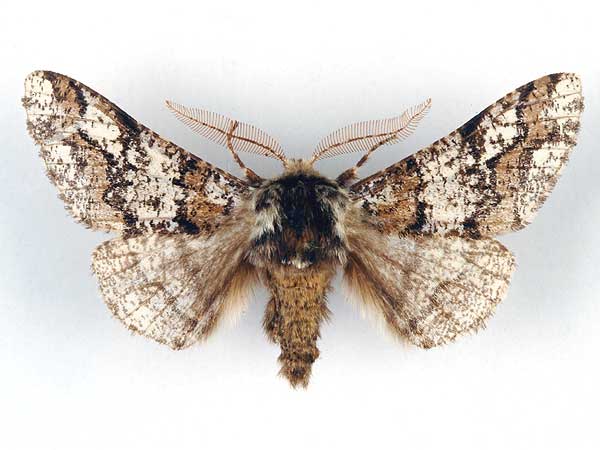
Description: Wingspan 51-56mm. Forewings are generally a mixture of mottled brown and white, with a distinct darkish band running across the outer edge of the forewing. The males have long feathery antennae and the body is quite hairy. From mid-March to early April, although in some milder years the emergence can be earlier.
World Distribution: Central and southern Europe east to Asia Minor.
Irish Distribution: Mainly confined to western counties at well-trapped sites such as, Crom and Garvary, where it is taken regularly in most years. Increased fieldwork in the east has led to its discovery at the Argory and Peatlands in the late 1990's and its rediscovery at Rostrevor in south east Down, where it hadn't been seen since the early part of the twentieth century. An early spring species, which may exist in small isolated populations at a few other woodland sites, particularly in Antrim around Glenarm and Banagher in Londonderry, where suitable habitat exists.
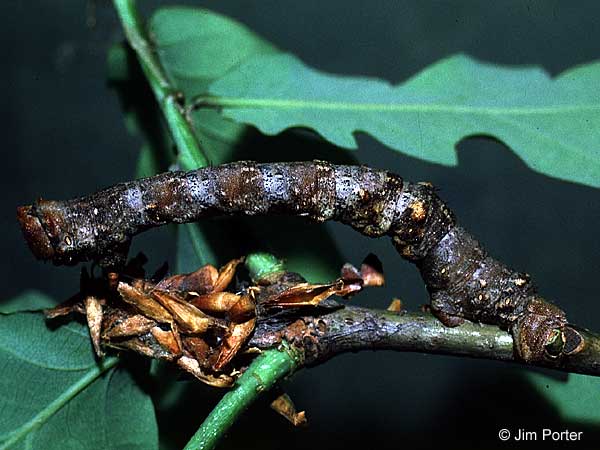
Ecology: An attractive species associated mainly with old established woodland. Adult males are frequently seen at light, females less so. Their mottled appearance aids their concealment when at rest during the day on the trunks of trees. The larvae can be found on a variety of trees including oak Quercus spp., elm Ulmus spp., Hazel Corylus avellana, Aspen Populus tremula and Alder Alnus glutinosa from late spring onwards. It overwinters in the pupal stage.
Key Identification Features:
- Early flight period
- Difficult to confuse with any other species at this time of year
 |
 |
Distribution Map from NBN: Biston strataria at National Biodiversity Network mapping facility, data for UK.
iNaturalist: Biston strataria at iNaturalist World Species Observations database.
| Thompson, R. & Nelson, B. (2023). Biston strataria. (Hufnagel, 1767). [In] Moths of Northern Ireland. https://habitas.org/moths/species.php?item=6021. Accessed on 2026-11-02. |