
| Insecta : Lepidoptera : Geometridae | Butterflies and Moths |
Eupithecia trisignaria Herrich-Schaffer, 1848
Triple-spotted Pug
 |
| Eupithecia trisignaria |
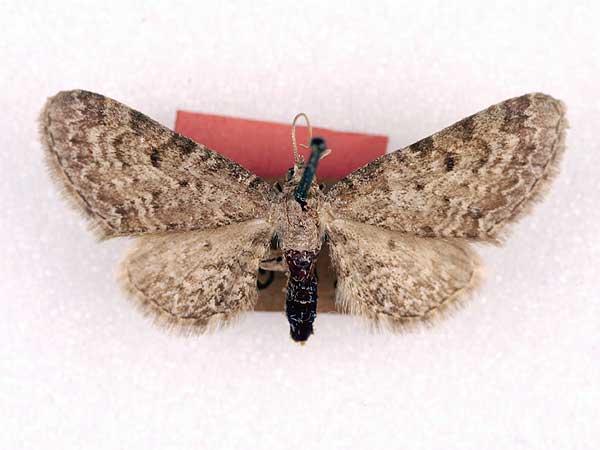
Description: Wingspan 15-20 mm. Forewings pale brown with a glossy appearance. The most useful diagnostic feature is two dark-coloured blotches and a small black discal spot at the costal edge of the wing. The hindwings slightly paler with a small black discal spot. End of June until late August. Skinner gives late June and July as the normal flight period in Britain.
World Distribution: Widespread throughout central Europe.
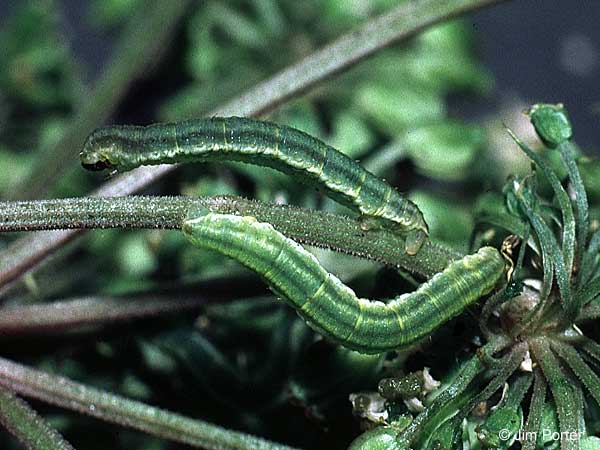
Irish Distribution: Confined to southern counties. This species was previouslly regarded as being rare in N. Ireland. The first record, from the Enniskillen area of Fermanagh in the early twentieth century, was of larvae found feeding on Wild Angelica Angelica sylvestris. There are more recent records from the mid-1990s onwards from Aghalane Bridge and Crom Estate, Fermanagh, Hillsborough Forest, Down, Crockacleaven Lough, Tyrone and Dartry Lodge and Mullanary, Armagh.
Ecology: A species associated mainly with fens, wet woodland margins and other marshy habitats. Adults come to light in very small numbers. The larvae feed throughout September on the seeds of Wild Angelica Angelica sylvestris and Hogweed Heracleum sphondylium. It overwinters as a pupa.
Key Identification Features:
- Dark-coloured blotches at the costal edge of the forewing
- Discal spot on hindwing
 |
Distribution Map from NBN: Eupithecia trisignaria at National Biodiversity Network mapping facility, data for UK.
iNaturalist: Eupithecia trisignaria at iNaturalist World Species Observations database.
| Thompson, R. & Nelson, B. (2023). Eupithecia trisignaria. Herrich-Schaffer, 1848. [In] Moths of Northern Ireland. https://habitas.org/moths/species.php?item=5910. Accessed on 2026-11-02. |