
| Insecta : Lepidoptera : Geometridae | Butterflies and Moths |
Eupithecia abietaria (Goeze, 1781)
Cloaked Pug
 |
| Eupithecia abietaria |
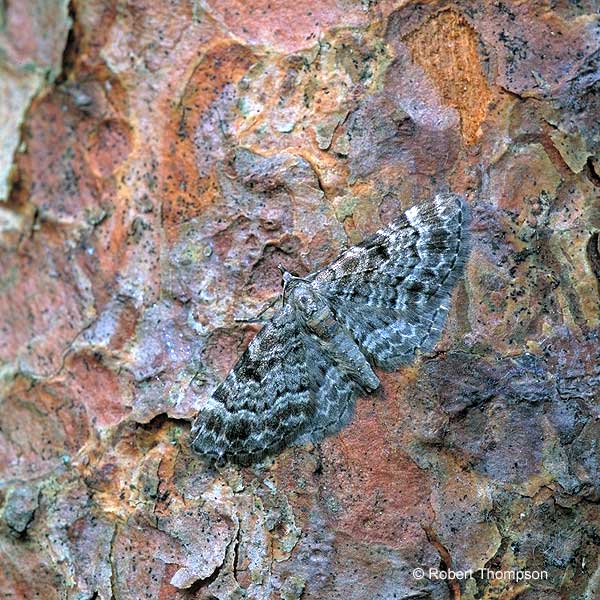
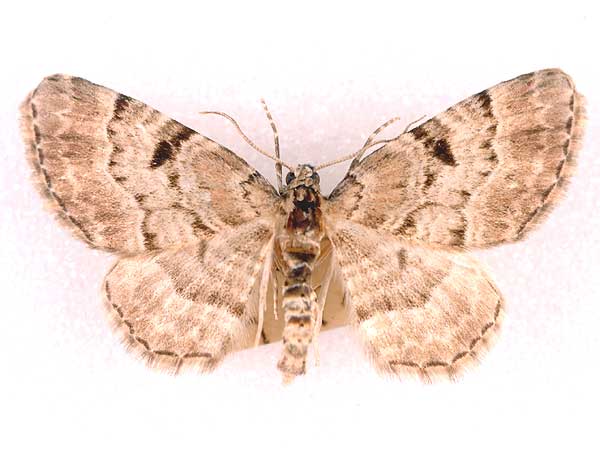
Description: Wingspan 21-25 mm. Forewings pale to darkish grey with dark broad crosslines. There is a large black discal spot near the median area of the forewing close to the costa and a fine broken black line along the outer margin of the forewing. Hindwings paler with a small discal spot. End of May to late July. Skinner gives June and July as the normal flight period in Britain.
World Distribution: Throughout central and southern Europe, east to the Urals. It has also been found in North America.
Irish Distribution: This species was widely recorded in the early part of the nineteenth century and described by Donovan (1936) as widespread among spruce. It then seemed to undergo a dramatic decline both here and in Britain, with no reports in N. Ireland for many years. In 1999 a single specimen was taken at Bohill near Ballynahinch, Down which was initially thought to be a Grey Birch ~6043#Aethalura punctulata~. This misidentification was subsequently corrected by a leading British expert. Since then several other specimens have been taken in the same locality during 2000.
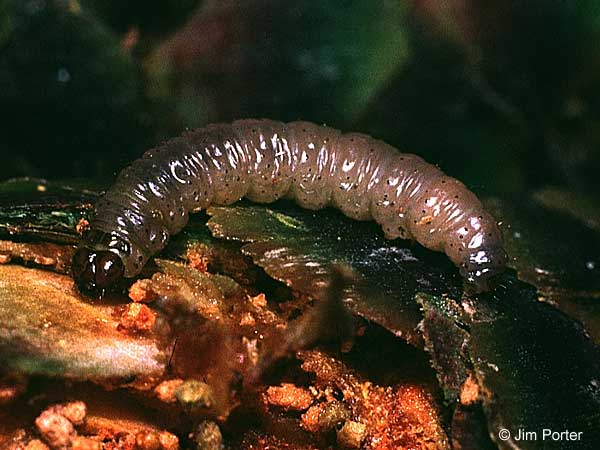
Ecology: A large distinctive pug mainly associated spruce plantations. All of the records to date have been of adults beaten from the foliage of various trees within a small area. The larvae feed inside on cones of Norway Spruce Picea abies, Noble Fir Abies procera and Silver Fir ~f39454A. alba~ during August and September. It overwinters as a pupa.
Key Identification Features:
- Large size
- Black discal spot and broken line on forewing
 |
 |
Distribution Map from NBN: Eupithecia abietaria at National Biodiversity Network mapping facility, data for UK.
iNaturalist: Eupithecia abietaria at iNaturalist World Species Observations database.
| Thompson, R. & Nelson, B. (2023). Eupithecia abietaria. (Goeze, 1781). [In] Moths of Northern Ireland. https://habitas.org/moths/species.php?item=5897. Accessed on 2026-11-02. |