
| Insecta : Lepidoptera : Nymphalidae | Butterflies and Moths |
Argynnis aglaja (Linnaeus, 1758)
Dark Green Fritillary
 |
| Argynnis aglaja |
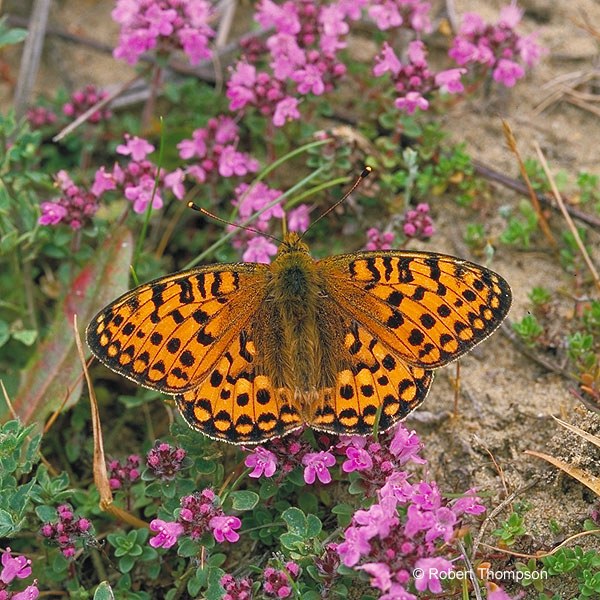
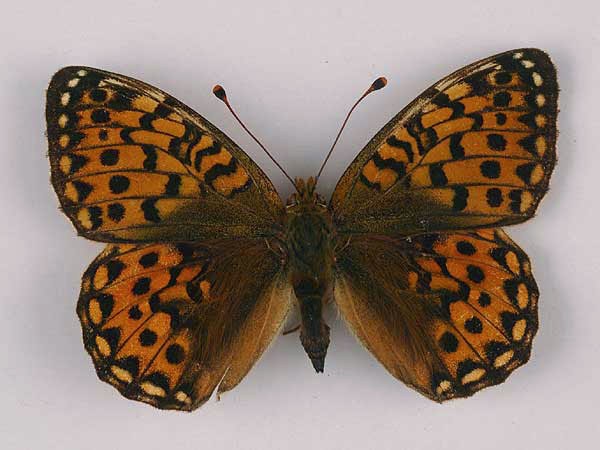
Description: Wingspan 69-80mm. Males are smaller than females. The male has bright orange uppersides marked with black along veins and with many round and triangular black spots. The female is similar but is less brightly coloured and with more extensive black markings. The underside of the hindwing in both sexes is mainly green with clear silver spots. The side margin of the forewings is straight or slightly convex Univoltine and mainly mid-June to mid-August.
World Distribution: Whole of Europe apart from Mediterranean islands except Sicily, Atlas Mtns of Morocco; Asia to China and Japan .
Irish Distribution: Very locally distributed in N. Ireland. Colonies exist on the dune systems and other coastal sites in Down and on the north coast between Magilligan Point, Londonderry and White Park Bay in Antrim. Inland populations are found in the Mournes, on Slieve Gullion in Armagh and in west Fermanagh. The status of it in some areas is uncertain. Coastal populations seem stable but there may have been declines inland.
Ecology: A colonial species found in open habitats. In N. Ireland mainly a species of dunes and coastal grassland and less commonly on inland heath and grassland. Males fly strongly through colony searching for females. Mated females fly low over vegetation searching for clumps of foodplants, which are species of violet Viola. They select large-leaved plants growing in moist locations, typically within a dense sward. Overwinters as a first instar larva.
Key Identification Features:
- Upperside is orange with black markings
- Underside of hindwing is green with clear silver spots
- Outer margin of forewing is straight or slightly convex.
 |
 |
Distribution Map from NBN: Argynnis aglaja at National Biodiversity Network mapping facility, data for UK.
iNaturalist: Argynnis aglaja at iNaturalist World Species Observations database.
| Thompson, R. & Nelson, B. (2023). Argynnis aglaja. (Linnaeus, 1758). [In] Moths of Northern Ireland. https://habitas.org/moths/species.php?item=5565. Accessed on 2026-11-02. |