
| Insecta : Lepidoptera : Lycaenidae | Butterflies and Moths |
Lycaena phlaeas (Linnaeus, 1758)
Small Copper
 |
| Lycaena phlaeas |
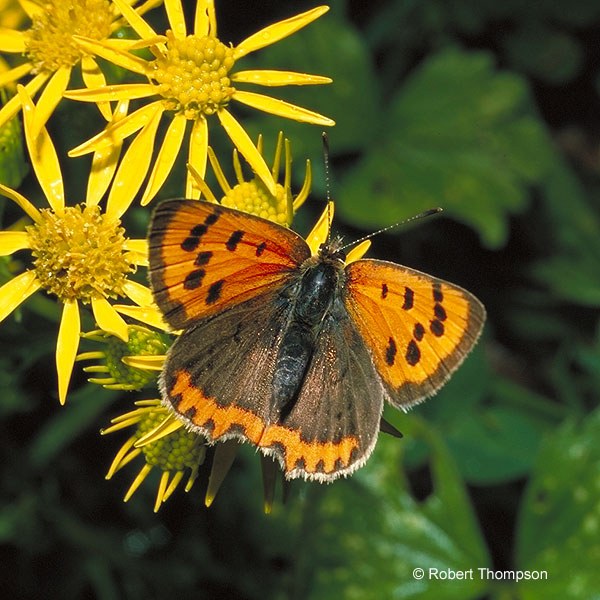
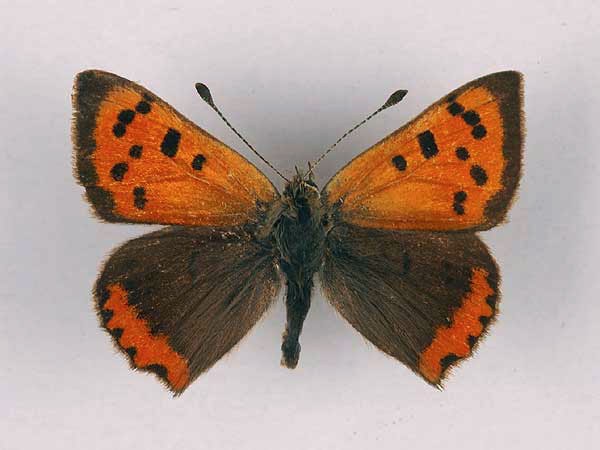
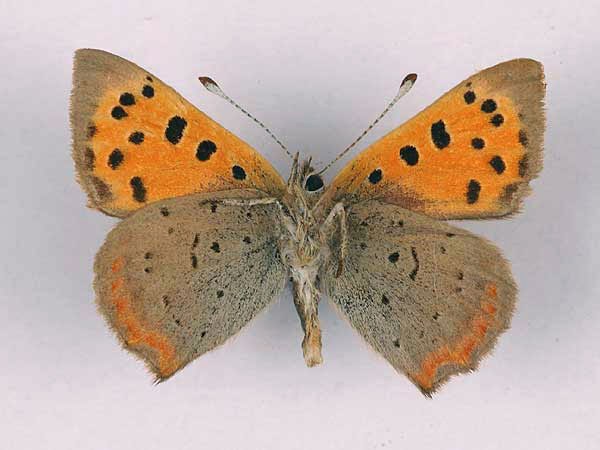
Description: Wingspan 26-36mm. The upperside of the forewings is copper coloured with small black spots and a narrow black band along the outer margin. The hindwings are dark brown with a coppery band close to the hind margin. The underside of the forewings are coppery with small black spots; the hindwing is pale brown with black dots. Females differ from males in being larger and slightly duller. Bivoltine in N. Ireland. The first generation flies in mid April to the end of June and the second in July and August. Numbers are usually highest in the summer brood.
World Distribution: Throughout Europe as far north as 70ºN, north west Africa, Asia to Japan and eastern North America.
Irish Distribution: This is found throughout N. Ireland, though it is scarce in the north and west and in upland areas.
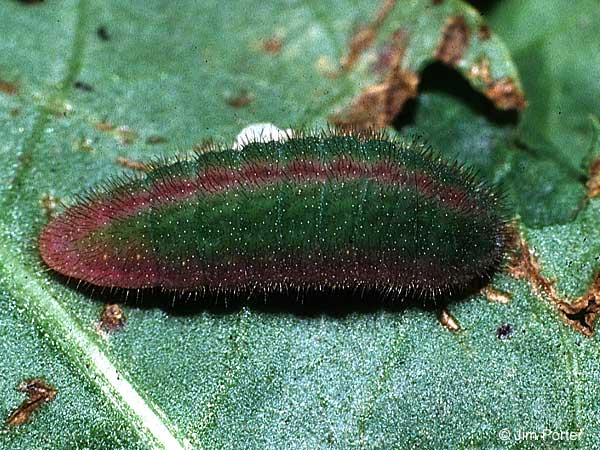
Ecology: The Small Copper is found in lowland unimproved grassland of all types, in open woodland and along hedgerows. The species is colonial, often occupying small areas of habitat, but individuals do wander. Adults are very active constantly moving even when perched. Males occupy sunny perches and defend them against any passing insect, returning if it is not a female. Females are pursued by males in a vigorous zigzag flight presumed to be aerial courtship. Egg-laying females fly low over vegetation, settling frequently looking for foodplants, Common Sorrel Rumex acetosa or Sheep's Sorrel R. acetosella. The larvae overwinter in an early instar.
Key Identification Features:
- Copper coloured forewings with black spots
 |
 |
 |
Distribution Map from NBN: Lycaena phlaeas at National Biodiversity Network mapping facility, data for UK.
iNaturalist: Lycaena phlaeas at iNaturalist World Species Observations database.
| Thompson, R. & Nelson, B. (2023). Lycaena phlaeas. (Linnaeus, 1758). [In] Moths of Northern Ireland. https://habitas.org/moths/species.php?item=5534. Accessed on 2026-11-02. |